
Maternal age
Intrauterine Insemination (IUI) in Kuala Lumpur
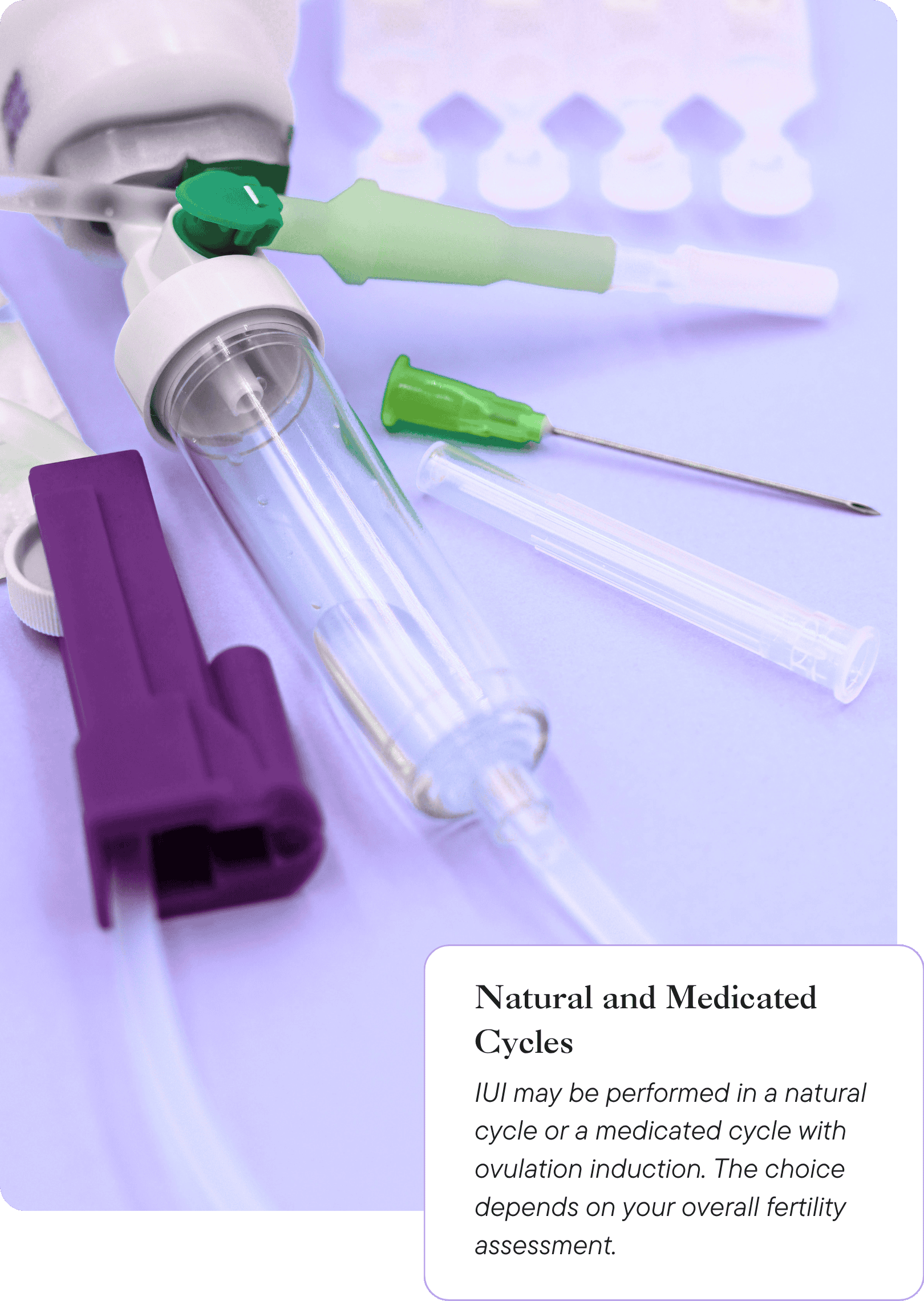
Intrauterine Insemination (IUI) is a procedure in which a prepared sperm sample is placed directly into the uterus around the time of ovulation to support fertilisation.
It is generally considered less complex than IVF and may be appropriate in selected situations depending on clinical findings. IUI may be considered in cases of mild sperm abnormalities or for women who experience irregular ovulation.
A consultation allows for review of your medical history, test results,
and whether IUI aligns with your overall treatment plan.
A consultation allows for review of your medical history, test results, and whether IUI aligns with your overall treatment plan.
When Might IUI Be Recommended?
Following evaluation, IUI may be discussed in situations where a less invasive approach is clinically appropriate.

Mild male factor infertility
Such as slightly reduced sperm count or motility.

Unexplained infertility
When standard fertility tests appear normal but pregnancy has not occurred.

Ovulatory disorders
Including irregular ovulation or conditions like Polyendocrine Metabolic Ovarian Syndrome (PMOS).

Cervical factor infertility
Where cervical mucus may make it difficult for sperm to reach the uterus.

Difficulty with timed intercourse
Where coordinating intercourse around ovulation is challenging due to medical, logistical, or personal circumstances.
Suitability depends on age, reproductive health, and duration of infertility. A detailed assessment is required before proceeding.
Suitability depends on age, reproductive health, and duration of infertility.
A detailed assessment is required before proceeding.
What to Expect During an IUI Cycle
If IUI is recommended, treatment typically takes place within one menstrual cycle and involves several coordinated steps.
Cycle Monitoring
Your cycle may be monitored through ultrasound scans and, where necessary, blood tests. In some cases, medication is prescribed to support ovulation.
Timing of Ovulation
When ovulation is detected — or medically triggered — insemination is scheduled to coincide with the most fertile window.
Sperm Preparation
When ovulation is detected — or medically triggered — insemination is scheduled to coincide with the most fertile window.
Insemination
The prepared sperm is gently placed into the uterus using a thin catheter. The procedure is brief and typically does not require anaesthesia.
Pregnancy Testing
A blood test is performed approximately two weeks later to assess for pregnancy.
Throughout the cycle, your doctor will explain each stage so that expectations remain clear.
Factors That May Influence Outcome
The likelihood of pregnancy with IUI can be influenced by several clinical factors:
During consultation, expected outcomes and alternative treatment pathways will be discussed openly.
Risks and Considerations
IUI is generally less invasive than IVF but may involve considerations such as:
These risks, along with potential alternatives, will be reviewed before proceeding.
Discuss Your Options
If you would like to understand whether IUI may be appropriate in your situation, we invite you to speak with our team.
If you would like to understand whether IUI may be appropriate in
your situation, we invite you to speak with our team.
A consultation provides time to review your fertility assessment and
consider next steps in a structured and informed way.
A consultation provides time to review your fertility assessment and consider next steps in a structured and informed way.
Important Notice
This information is provided for general educational purposes only and does not replace medical consultation. Treatment suitability and outcomes vary by individual. A consultation with a registered medical practitioner is required before initiating fertility treatment.